
Lithgow
Lithgow sits about 300 metres higher than Bathurst and takes roughly 210mm more rain a year, and it is built on the sandstone country at the western edge of the Blue Mountains rather than the granite and basalt further west. Those three facts change most of what matters on a property here: how often grass needs cutting, how the ground behaves when you dig it, and how long the frost window runs. We work across Lithgow, Portland, Wallerawang and the villages around them, and the schedule is set to this district rather than carried across from the Bathurst round.
What we do in Lithgow
Every service below is available across Lithgow and the surrounding Central West NSW district.
Lawn mowing and garden maintenance in Lithgow
Lithgow averages around 860mm of rain a year against Bathurst's 648mm, and the mean maximum sits near 18.2C against Bathurst's 20.8C. More water and less heat is a combination that keeps lawns growing steadily rather than in the hard bursts you get in drier towns, so the mowing cycle here is about consistency rather than chasing a spring surge. The trade-off is that ground stays wet longer after rain, so there are more weeks where the timing of a visit matters as much as the frequency.
More on residential servicesLandscaping in Lithgow
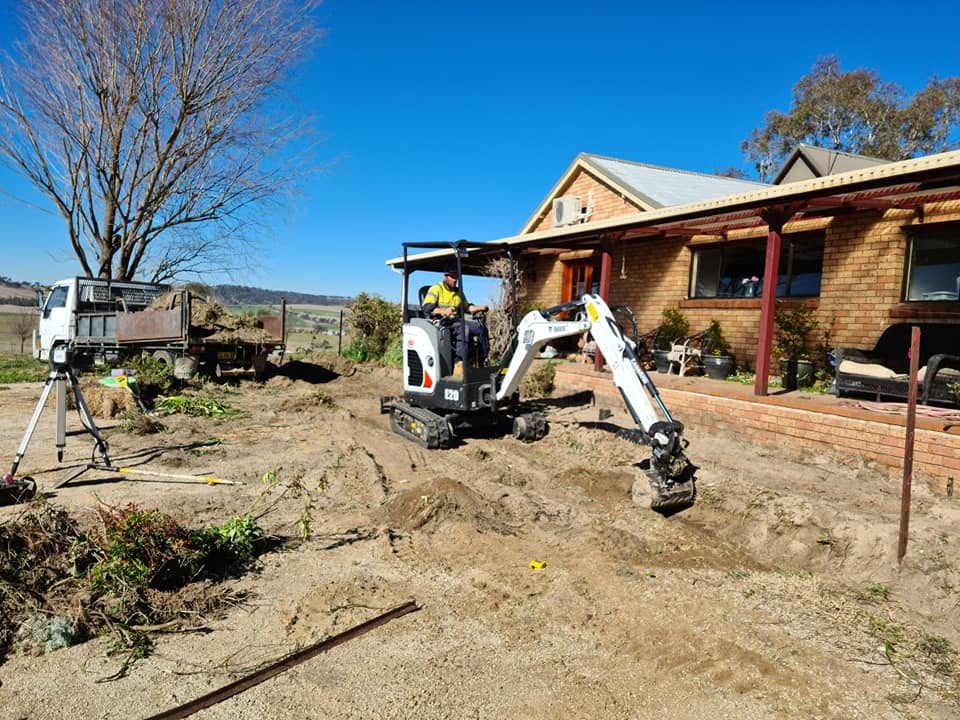
Sandstone country behaves differently to the basalt and granite further west. Rock sits shallow in a lot of Lithgow, which limits how deep beds can be cut and often decides whether a level change is built up rather than dug down. Retaining walls here are frequently the practical answer to a slope rather than a design choice. Because we run our own excavators, we find out what is actually under a site early rather than pricing a job on the assumption that it can be dug.
More on landscapingEarthworks and excavation in Lithgow
Shallow sandstone is the defining constraint on excavation around Lithgow, and it is the main reason a trench that looks straightforward on the surface takes longer than the metres suggest. It changes machine selection too: rock is a job for the E50 rather than the E20, and there are sites where the answer is to redesign around it instead of trying to break through it. Higher rainfall also means drainage falls have to be right, because water that has nowhere to go on tight ground finds a building instead.
More on earthworks & excavationAcreage mowing and slashing in Lithgow
Blocks around Lithgow, Portland and Wallerawang tend to be a mix of cleared paddock and timbered country, with more regrowth pressure than open grazing land carries. The extra rainfall drives that regrowth hard. We run slashers in several sizes across the Bobcat skid steers, a forestry mulcher for woody regrowth and scrub, and a flail mower on the excavator for drains and rough edges, which covers most of what these blocks need without burning or raking afterwards.
More on rural & acreage servicesCommercial grounds maintenance in Lithgow
Standing contracts run the same way here as in Bathurst: an agreed scope and frequency, the same crew on the cycle, and noisy work planned around teaching hours, quiet periods and site access. What changes is the seasonal shape. A Lithgow site holds growth later into autumn than a Bathurst one and starts slower in spring, so a frequency copied straight across usually ends up wrong at both ends of the year.
More on commercial grounds maintenanceWeed control in Lithgow
Lithgow sits under the Central Tablelands Weeds Authority, the same control authority as Bathurst Regional, Blayney and Oberon, so priority weed listings here match what applies at home rather than differing the way Orange does. Priority weeds are set regionally under the NSW Biosecurity Act 2015 and grouped as prevent, eradicate, contain and asset protection. Wetter ground and more regrowth mean blackberry and woody weeds are a bigger share of the work here than they are further west.
More on weed managementResidential Services in Lithgow
Lawn mowing, garden maintenance and property upkeep for homes and weekenders.
Learn moreCommercial Grounds Maintenance in Lithgow
Scheduled grounds maintenance for schools, education campuses, aged care, strata and industrial sites.
Learn moreLandscaping in Lithgow
Landscape renovations, garden beds, retaining walls and property makeovers.
Learn moreRural & Acreage Services in Lithgow
Acreage mowing, slashing and property maintenance for rural landholders.
Learn moreWeed Management in Lithgow
Weed control and herbicide application, including noxious weed management.
Learn moreEarthworks & Excavation in Lithgow
Bobcat work, trenching and site preparation for small and large earthworks projects.
Learn moreCommon Questions
Working in Lithgow.
Do you travel to Lithgow?
Yes. Lithgow is about an hour east of our base at Kelso, and we cover Portland and Wallerawang on the same runs. How far out we go depends on the size of the job, so it is worth asking.
How is Lithgow different to work in than Bathurst?
Higher and wetter. Lithgow is around 950 metres against Bathurst's 650, takes roughly 860mm of rain against 648mm, and runs a couple of degrees cooler through the day. It also sits on sandstone rather than granite or basalt, which matters most for digging.
Does the rock affect what excavation you can do?
Often, yes. Sandstone sits shallow across a lot of Lithgow, which is the usual reason a trench or a cut takes longer than the metres suggest. We would rather find that out on a site visit than discover it halfway through.
Do you cover Portland and Wallerawang?
Yes, both, along with the villages around them. They sit in the same council area and the same growing conditions, so they run on the same schedule as Lithgow.
Who regulates priority weeds in Lithgow?
The Central Tablelands Weeds Authority, which also covers Bathurst Regional, Blayney and Oberon. Priority weeds are set regionally under the NSW Biosecurity Act 2015.